



HARMONIC EXPANSIONS
CHAPTER 3: 6/4 LINEAR EXPANSIONS
3.7 The Arpeggiated 6/4
 |
 |
 |
|
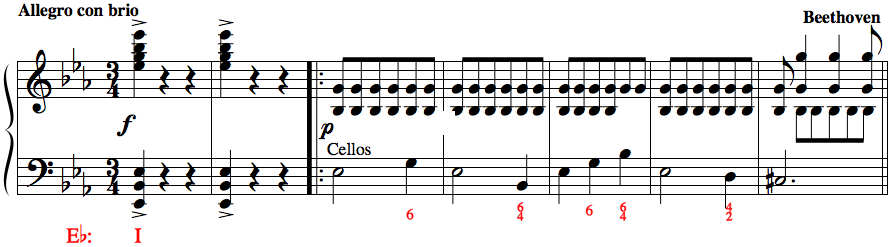
After two opening forte chords, Beethoven's "Eroica" symphony features a melody in the cellos which contains consonant skips in the tonic triad and which reaches scale degree 5 at the end of measures 4 and 5--see the piano reduction above. At these points second inversion tonic chords are briefly formed, indicated by the 6/4's under the staff. These 6/4's are called arpeggiated 6/4's, the name comes from the arpeggiations in the lowest voice.
Arpeggiated 6/4's differ from other 6/4's in at least two ways:
- Arpeggiated 6/4's are not derived from nonharmonic tone expansions. Rather they result from expansions by consonant skip.
- While these skips are common in instrumental music, they are rare in choral music, the traditional model for studying voice leading.
|
Nevertheless, for consistency within this site, the video to the right shows two arpeggiated 6/4s in a choral texture, one 6/4 expanding the initial tonic and the other expanding the dominant. Although the 6/4 in measure 2 is not part of a full arpeggio--it merely skips back and forth from the root--Music Theorists still call it, "arpeggiated." |
|
|
In the first two measures of the fourth movement of Schubert's Piano Sonata D.850 (below), arpeggiated 6/4's are formed by the lowest note simply alternating from tonic to dominant. Repetitions of this kind are common in instrumental music. |
|
|
|
 |
|
Comments? Click here. |
